Why Your $500 App is Costing You $50k in Ad Efficiency
You're spending $100K+ monthly on acquisition. You're hitting ROAS targets on paper. But when you look at the P&L quarterly, contribution margin isn't scaling with spend.
Here's why: You're feeding the ad algorithms the wrong data.
Most fashion brands use standard Shopify tracking that sends two data points to Meta: Order Value and Currency. The algorithm does exactly what it's told—finds customers who generate revenue. But not all revenue is equal.
The Problem: Your Ad Platforms Don't Know Which Customers Are Profitable
Here's what your standard tracking sees:
Customer A:
- Orders: 1 dress ($120)
- Returns: None
- Refunds: None
- Net Revenue: $120
- Margin: ~$60 (50%)
Customer B:
- Orders: 3 dresses ($360 total)
- Returns: 2 dresses
- Refunds: 1 dress
- Net Revenue: $120
- Margin: ~$20 (17%)
What standard tracking tells Meta: Customer B is 3x more valuable than Customer A.
The result: Your algorithm burns budget finding more "Customer Bs"—serial returners and discount hunters who inflate revenue but destroy margin.
This mess-up isn't a tracking problem. It's a data quality problem.
The "One-Size-Fits-All" Trap:
Apps like Elevar or Littledata are the "fast fashion" of tracking: affordable ($200-500/mo) and quick to install. But they are built for the average merchant, not the scaling fashion brand. They force your complex business logic into a generic box.
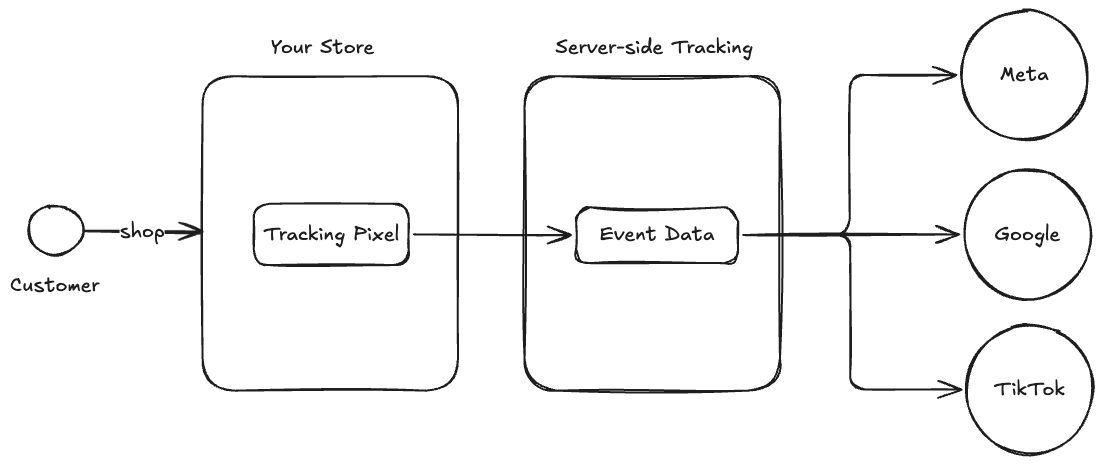
- The "Dumb Pipe" Problem: These apps function as data pipes—they send raw events. They cannot add the context that drives profit, such as calculating net margin per cart or identifying high-LTV cohorts, before the data hits Meta.
- The EMQ Wall: Generic apps typically max out at an Event Match Quality (EMQ) of 8.0–8.5. To compete with the best, you need the granularity that pushes you to 9.0–9.5, which requires custom customer data matching that apps don't design for.
- The "Last 20%" Gap: Generic apps get you 80% of the way there. But in a competitive market, the "last 20%" of data quality—enriched signals and custom attributes—is where the competitive advantage lives.
The Solution: Enriched signals Server-Side Tracking
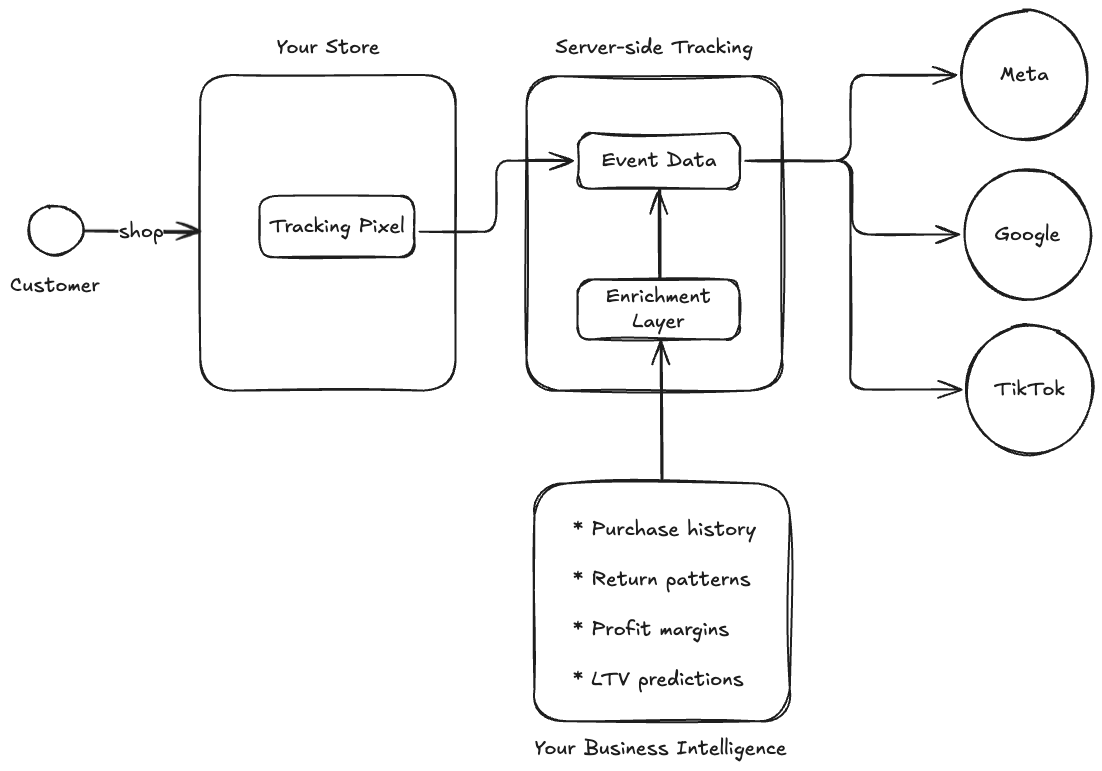
Enterprise brands use custom server-side tracking that adds strategic context before data reaches ad platforms:
With enriched signals, ad algorithms can optimize for profit, not just revenue.
Here's how it works differently:
Standard App Flow:
Enriched Signal Flow:
When You Need to Upgrade
You should consider margin-aware tracking if:
- Monthly ad spend exceeds $75K - Optimization improvements pay for themselves
- Return rate above 15% - Standard tracking is actively harming performance
- Significant margin variance - Some products are 3x more profitable than others
- High customer acquisition costs - Need to maximize value per converted customer
Real-World Impact
A $200K/month fashion brand we audited was spending heavily on acquisition campaigns. Their tracking showed healthy ROAS, but profitability was declining.
The problem:
- Standard tracking couldn't differentiate between profitable and unprofitable customers
- Ad algorithms optimized for high-order-value customers
- Those customers had 2x higher return rates
- Net margins were 40% lower than expected
After implementing margin-aware signals:
- Ad algorithms learned to target lower-return customers
- Overall conversion volume decreased 12%
- Net profit increased 34%
The 80/20 Rule of Tracking
Generic tracking apps handle 80% of what you need:
- Event collection
- Basic server-side tracking
- Platform integrations
- Standard CAPI implementation
But the last 20% creates competitive moats:
- Business context enrichment
- Margin awareness
- Return prediction signals
- Customer value modeling
- Maximum Event Match Quality (9.0+)
How to Know If Your Tracking Is Costing You Money
Ask yourself:
- What's your Event Match Quality score? - Below 8.5 means lost signal
- Does your tracking know product margins? - If not, algorithms can't optimize for profit
- Can you differentiate high-LTV customers? - Standard tracking treats all customers equally
- Is your return rate above 15%? - Generic tracking is likely optimizing for returners
Key Takeaways
- Standard tracking optimizes for order value, not profitability
- Generic apps (Elevar, Littledata) are great for basic needs but lack business context
- Margin-aware server-side tracking adds profitability signals to ad platforms
- Enterprise brands use enriched data to optimize for profit, not revenue
- The investment pays for itself at $75K+/month in ad spend
- Maximum Event Match Quality (9.0+) requires custom implementation
Don't let a $500/month app cost you $50K/year in ad efficiency. Make your tracking work for profitability, not just volume.